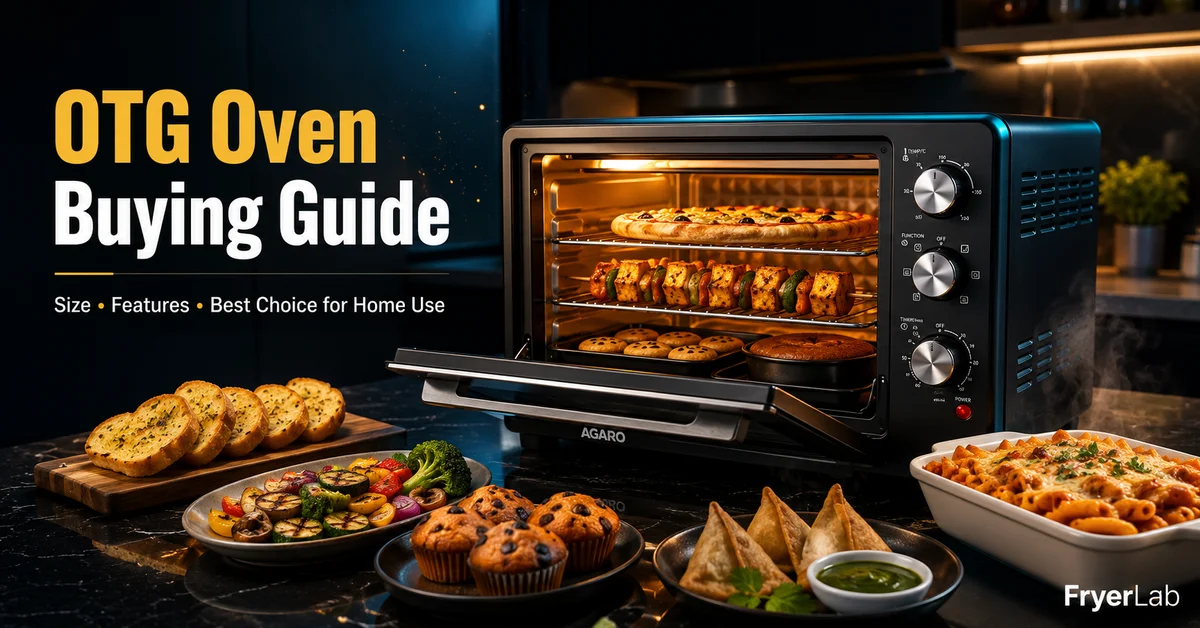

Buying your first OTG can be confusing. One model is 19 litres, another is 30 litres, while a costlier option promises convection, rotisserie, digital presets and air-frying. Product pages may look impressive, but they often miss practical questions: Will my cake tin fit? What is the right OTG oven size for family of 4? Will it take too much counter space?
This OTG Oven Buying Guide answers these questions in simple language. It is written for beginners who want to bake, grill, toast or reheat food without choosing the wrong capacity.
This guide uses current specifications and practical buying factors, not fake testing claims. By the end, you will know how to choose OTG oven size, power, controls, accessories and features according to your family.
What Is an OTG Oven?
OTG stands for Oven, Toaster and Griller. It is a compact electric oven that normally uses heating rods at the top and bottom of the chamber. Depending on the mode selected, the appliance can use the lower element, upper element or both elements for baking, toasting, grilling and roasting.
An OTG heats the cooking chamber and food through its heating elements. It is different from a microwave, which mainly uses microwave energy. Because an OTG produces direct dry heat, it is well suited to browning cheese, forming a cake crust, crisping biscuits and grilling paneer or chicken.
An OTG is not always the fastest appliance for reheating dal, rice or curry. Its strength is baking, roasting, grilling and creating a crisp or browned surface.
Why an OTG Is Useful for Indian Homes
A good OTG is not limited to cakes and cookies. It can prepare many foods commonly enjoyed in Indian homes:
- Paneer tikka, mushroom tikka and grilled vegetables
- Chicken tikka, kebabs and roast chicken
- Samosa, kachori, cutlets and patties
- Pizza, garlic bread and open sandwiches
- Nankhatai, biscuits, bread and tea cakes
- Baked pasta and vegetables
- Toasted papad, nuts and seeds
- Reheated fried snacks with a crisper surface
The main advantage is control. You can select temperature, cooking time, rack position and heating mode according to the recipe. Beginners need some practice, but the control becomes valuable quickly.
This OTG Oven Buying Guide also considers Indian kitchen realities: limited counter space, family size, electricity use, suitable sockets, cleaning effort and service support. A larger OTG is not automatically better. The right model is the smallest size that comfortably handles the largest dish you genuinely plan to cook.
How to Choose OTG Oven Capacity
Capacity is shown in litres, but litres do not tell the complete story. Two 30-litre models can have different internal widths, heights and tray dimensions. Check the usable chamber size when you plan to use a specific cake tin, pizza pan, loaf tin or rotisserie.
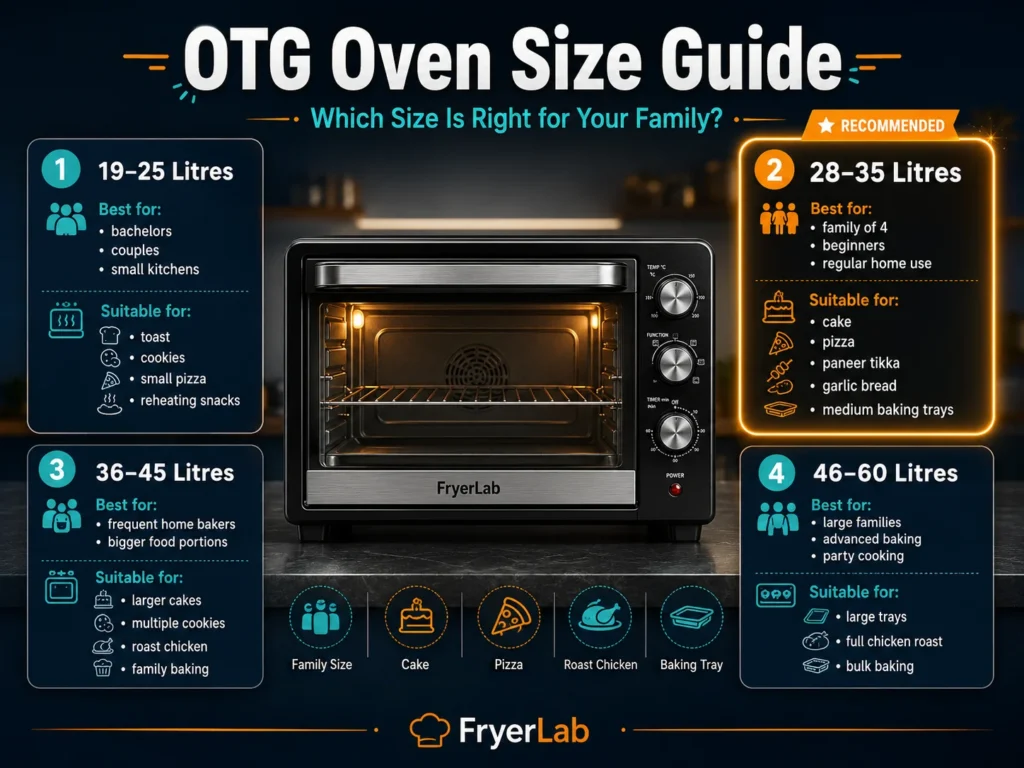
| OTG Capacity | Suitable For | Practical Uses |
|---|---|---|
| 9–19 litres | One or two people | Toast, small pizza, reheating, small cake |
| 20–28 litres | Two to four people | Beginner baking, cookies, paneer tikka |
| 29–35 litres | Three to five people | Regular baking, larger tins, chicken pieces |
| 36–45 litres | Four to six people | Large batches, breads, whole chicken |
| 46–60 litres | Large families or serious bakers | Entertaining, big trays, frequent baking |
Your largest recipe and baking frequency matter more than family count alone.
OTG Oven Size for Family of 4
For most Indian homes, the ideal OTG oven size for family of 4 is around 28 to 35 litres. This range usually provides enough space for a medium cake, regular pizza, paneer tikka, cookies or a family-sized snack batch without making the appliance unnecessarily bulky.
Choose closer to 28 litres when you bake occasionally and mainly make toast, snacks or small cakes. Choose 32 to 35 litres when you plan to bake every week, use wider tins or roast larger portions. A 35 to 40-litre model may be better when you want a whole chicken or bigger batches for guests.
The correct OTG oven size for family of 4 therefore depends on your largest dish. Measure the available counter and compare it with the appliance’s external dimensions before buying.
Key Specifications to Check
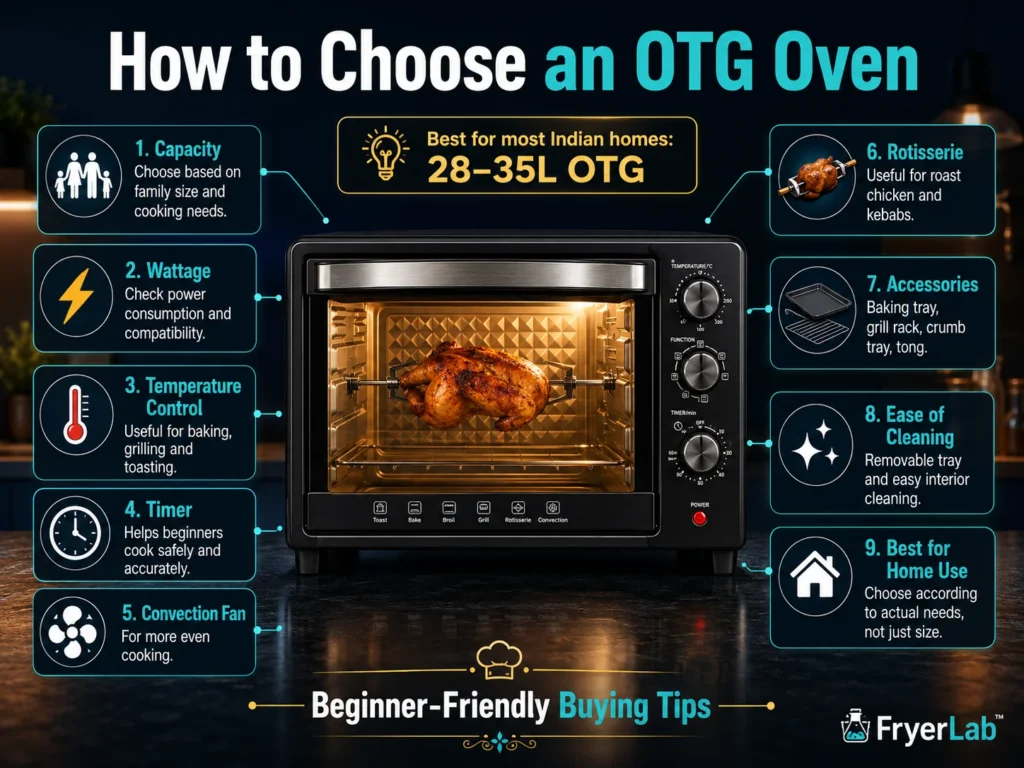
This OTG Oven Buying Guide recommends comparing these details rather than choosing only by discount or appearance.
| Specification | What Beginners Should Check |
| Brand | Service availability, warranty and replacement accessories |
| Capacity | 28–35 litres suits many four-member families |
| Wattage | Match power with chamber size; do not judge performance by watts alone |
| Temperature | Clear thermostat markings and a useful baking-to-grilling range |
| Timer | 60 minutes is enough for many recipes; longer timers help slow roasting |
| Heating modes | Separate upper, lower and combined heating |
| Convection | Useful for air circulation and more even browning |
| Rotisserie | Useful for whole chicken, kebabs and rotating roasts |
| Accessories | Baking tray, wire rack, crumb tray, tongs and rotisserie parts |
| Amazon price | Compare seller, warranty, return policy and included accessories |
Official listings show why wattage should be considered with capacity. Wonderchef lists a 19-litre OTG at 1280W, Bajaj lists a 25-litre air-fryer OTG at 1550W, and Philips lists larger digital OTGs at 2000W. These examples show that capacity and feature set influence power requirements, but higher wattage alone does not guarantee better results.
Looking to buy an OTG oven? [Check the latest OTG oven prices on Amazon] and compare current offers, sizes, and features before purchasing.
How Much Electricity Does an OTG Use?
An OTG’s wattage indicates its maximum electrical load when the heating elements are working. A 1500W appliance running continuously for one hour would theoretically use 1.5 units of electricity.
Use this simple estimate:
Electricity units = Wattage ÷ 1000 × Cooking time in hours
A 1500W OTG used for 40 minutes gives a maximum theoretical estimate of roughly one unit:
1.5 × 0.67 = about 1 unit
Actual use can be lower because the thermostat cycles the elements. Preheating, chamber size and temperature also affect consumption.
For most households, buying the correct capacity is more useful than selecting a weak OTG that takes longer to heat or cook.
Important Features Explained
Temperature Control
A thermostat lets you select cooking temperature. Cakes and cookies generally need controlled moderate heat, while pizza and grilling usually require higher heat. Exact requirements depend on the recipe.
Thermostat markings may not be perfectly accurate in every model. Beginners should observe browning and cooking time. Serious bakers can use a separate oven thermometer to understand their OTG better.
Timer and Auto Shut-Off
A timer switches the OTG off after the selected duration and usually sounds a bell. Auto shut-off is a useful safety and convenience feature. Some digital models offer longer timers and presets, while basic models use simple manual knobs.
Upper and Lower Heating
Look for control over upper heat, lower heat and both heating elements. Lower heat helps cook the base, upper heat helps browning and grilling, and both elements are commonly used for balanced baking.
Do not use one setting for every recipe. Follow the manufacturer’s manual first, then adjust rack position or heat selection after understanding the results.
Convection Fan
A convection fan circulates hot air inside the chamber. It can improve heat distribution and browning, particularly in medium and large OTGs. Wonderchef currently offers convection on selected 28-litre and 60-litre models, while Philips lists convection on its larger digital range.
Convection is useful but not compulsory. Some delicate cakes may need a lower temperature or fan-free setting. Recipe instructions and the oven manual should guide the first attempt.
Rotisserie
A motorised rotisserie turns food slowly near the heating elements. It is useful for whole chicken, kebabs and rotating vegetable or paneer preparations. Check chamber clearance, maximum food weight and whether all rods, forks and tongs are included.
Vegetarian buyers who mainly want cakes and pizza may get more value from a wider chamber, good thermostat, chamber light and removable crumb tray than from rotisserie.
Digital Display and Presets
Digital controls simplify time and temperature selection. Some current Philips OTGs include preset menus, a digital panel and chamber light. These features are convenient, but they cannot account for every change in ingredient quantity, tin material or recipe moisture.
Manual knobs are simpler and often cheaper; digital electronics may cost more to repair after warranty.
Chamber Light and Crumb Tray
A chamber light lets you observe browning without opening the door repeatedly. Opening the door releases heat and can affect cakes and breads.
A removable crumb tray catches crumbs, cheese and food particles. It makes regular cleaning much easier. Also check whether the baking tray, wire rack and tray handle are strong enough for your intended dishes.
Which OTG Oven Is Best for Home Use?
There is no single answer to which OTG oven is best for home use. The best option is the one that matches your family, recipes, kitchen space and budget without adding features you will rarely use.
For a couple or occasional user, a 19 to 25-litre manual OTG may be enough. For a family of four, a 28 to 35-litre model with upper-and-lower heating, timer, auto shut-off, crumb tray and dependable service support is a balanced choice.
Frequent bakers should prioritise usable chamber width, thermostat consistency, rack positions, convection and a longer timer. Families that regularly cook whole chicken or kebabs may value rotisserie.
| Buyer Type | Recommended OTG Type |
| First-time cake and pizza maker | 25–30L simple manual or digital OTG |
| Family of four | 28–35L with convection option |
| Frequent home baker | 35–45L with wide chamber |
| Chicken and kebab lover | 30L or larger with rotisserie |
| Bachelor or small kitchen | 19–25L compact OTG |
| Large family | 45–60L model |
When deciding which OTG oven is best for home use, check warranty terms and authorised service in your city. A simpler model from a serviceable brand may be a better long-term purchase than a feature-heavy model with poor support.
Best Utensils for Induction Cooktop: Complete Buying Guide for Indian Kitchens
Performance for Indian Cooking
Samosa, Pakora and Cutlets
An OTG can reheat samosa, pakora and cutlets with a crisper surface than a normal microwave. Brush or spray a small amount of oil and turn the food midway. It may not exactly reproduce deep-fried texture, and an air fryer can be faster for small batches.
Paneer Tikka and Vegetables
Paneer tikka works very well in an OTG. Place it on a wire rack or skewers with a drip tray below. High heat and upper-element finishing can create browned edges. Avoid overcrowding because released moisture can steam the food.
Chicken and Kebabs
Chicken pieces can be grilled on a rack, while rotisserie models can cook a whole chicken when chamber size and weight limits permit. Cooking time varies with piece size and marination. Use safe cooking practices and do not judge doneness only from outside colour.
Pizza and Garlic Bread
A preheated OTG can give pizza a crisp base and browned cheese. Rack position and tray material influence the result. Stronger lower heat can help the base, while upper heat can finish the cheese.
Cakes, Cookies and Nankhatai
Baking is the main reason many people buy an OTG. Correct preheating, tin size, rack level and temperature are essential. Do not open the door repeatedly during the early part of cake baking. Leave enough space between cookies because they spread and brown faster near heating rods.
Roti and Paratha
An OTG can warm rotis or make baked variations, but it is not the best appliance for daily roti or paratha. A tawa is faster and produces more familiar results.
OTG vs Microwave vs Air Fryer
| Feature | OTG | Convection Microwave | Air Fryer |
| Main strength | Baking, grilling and browning | Fast reheating and multi-purpose cooking | Fast crisping of small batches |
| Cakes and bread | Very good with correct technique | Good in convection mode | Limited by basket size |
| Reheating dal or curry | Not ideal | Best option | Not suitable |
| Crispy snacks | Good but slower | Moderate | Fast and convenient |
| Whole chicken | Possible in larger OTGs | Possible in suitable models | Depends on basket capacity |
| Usable space | Wide range and larger trays | Usually moderate | Basket limits space |
| Learning curve | Medium | Medium to high | Low |
Choose an OTG when cakes, pizza, bread, grilling and large trays are your priority. Choose a microwave for fast reheating and defrosting. Choose an air fryer for quick crispy snacks in smaller quantities.
Combination air-fryer OTGs are also available. Bajaj currently lists models combining a 25-litre OTG with air-frying and 360-degree air circulation, while other brands sell larger convection and rotisserie combinations. Compare usable space, fan performance, accessories and cleaning effort before paying extra.
Induction Cooktop vs Gas Stove: Which Is Better for Indian Cooking? in 2026
Detailed OTG Buying Checklist
Before ordering, follow this OTG Oven Buying Guide checklist:
- Decide the largest cake tin, pizza or chicken you want to cook.
- Measure the counter, including door-opening space.
- Compare internal dimensions, not litres alone.
- Check wattage and use a suitable wall socket.
- Choose manual or digital controls according to your comfort.
- Confirm upper, lower and combined heating modes.
- Pay for convection or rotisserie only when you will use them.
- Check the tray, rack, crumb tray, tongs and rotisserie parts.
- Read warranty conditions and check service availability.
- Compare the final price, seller and return policy.
- Read recent buyer feedback about heating, door alignment and accessories.
Looking to buy an OTG oven? [Check the latest OTG oven prices on Amazon] and compare current offers, sizes, and features before purchasing.
Common Mistakes Beginners Make
Choosing Too Small
A 10 or 16-litre OTG oven can feel restrictive when you start using medium tins, pizza pans or family-sized batches. Buy for the largest recipe you expect to make regularly.
Choosing Too Large
A 60-litre OTG oven occupies more space and may take longer to preheat. It is unnecessary for someone who bakes a small cake once a month.
Ignoring Chamber Dimensions
Capacity does not guarantee that your existing tin will fit. Check tray width, chamber depth and clearance from the heating rods.
Expecting Microwave-Speed Reheating
An OTG oven is good for crispness and browning, but it is not the fastest choice for dal, rice or curry.
Skipping Preheating
Many baking recipes require a properly preheated chamber. Starting cold can affect rise, texture and cooking time.
Using Unsafe Cookware
Use oven-safe metal, ceramic or heat-resistant glass only when allowed by the manufacturer. Never place ordinary plastic inside an OTG.
Pros and Cons
Pros
- Excellent for cakes, cookies, bread and pizza
- Better browning and grilling than a basic microwave
- Available in many capacities
- Offers control over temperature, time and heating elements
- Useful for paneer tikka, kebabs and baked snacks
- Removable accessories are generally easy to clean
- Manual models can offer good value
Cons
- Requires preheating
- Slower than a microwave for routine reheating
- Exterior and glass can become very hot
- Temperature accuracy may vary
- Large models need significant counter space
- Beginners need practice with rack position and heating modes
- Grease from grilling takes time to clean
Who Should Buy an OTG?
An OTG suits home bakers, families that enjoy pizza and grilled dishes, parents who want baked snacks, and users who prefer control over browning and texture. It is also suitable for beginners willing to learn basic temperature and timing adjustments.
A medium-capacity model makes sense when the family will use it regularly.
Who Should Avoid an OTG?
Avoid an OTG when your main requirement is reheating tea, dal, rice and curry. A microwave is more convenient. An OTG may also be unnecessary when you only want small portions of fries or frozen snacks; a compact air fryer can be faster.
People with limited counter space should measure carefully. Avoid a large model when the kitchen lacks a suitable socket or enough ventilation around the appliance.
Price and Value for Money
OTG oven prices in India vary with capacity, brand, control type, convection, rotisserie, presets and accessories. Online prices change, so do not judge value only by discount percentage.
For beginners, a dependable 25 to 35-litre OTG with essential controls often offers better value than a premium model full of presets. Spend extra when you genuinely need a wider chamber, convection, rotisserie, digital control or stronger after-sales support.
The best value is not always the cheapest appliance. It is the OTG that fits your cookware, prepares your regular dishes and remains serviceable after the warranty period.
Final Verdict
For most four-member Indian families, a 28 to 35-litre OTG is the balanced choice. It offers enough room for cakes, pizza, paneer tikka, cookies and family-sized snacks without becoming excessively bulky.
This OTG Oven Buying Guide recommends prioritising chamber dimensions, dependable temperature control, upper-and-lower heating selection, auto shut-off, a removable crumb tray and local service support. Add convection when you bake or roast frequently. Add rotisserie only when it matches your cooking habits.
When buyers ask how to choose OTG oven or which OTG oven is best for home use, the honest answer is straightforward: choose according to your largest dish, weekly usage and available kitchen space. Do not pay for unused capacity or features.
Looking to buy an OTG oven? [Check the latest OTG oven prices on Amazon] and compare current offers, sizes, and features before purchasing.
Frequently Asked Questions
What Is the Best OTG oven Capacity for Beginners?
A 25 to 30-litre OTG is a practical starting point for many beginners. It can handle common cakes, pizza, cookies and grilled snacks while remaining manageable in a normal kitchen.
What Is the Ideal OTG Oven Size for Family of 4?
The practical OTG oven size for family of 4 is usually 28 to 35 litres. Consider 35 to 40 litres when you bake frequently, use wide tins or want to roast a whole chicken.
How to Choose OTG Oven for Baking Cakes?
Check chamber width, thermostat control, upper-and-lower heating, timer and rack positions. A chamber light and convection can help, but correct tin size and temperature control matter more.
Which OTG Oven Is Best for Home Use?
For many homes, a 28 to 35-litre model with reliable controls, auto shut-off, crumb tray and good service support is the best all-round choice.
Is Convection Necessary in an OTG oven ?
No. A standard OTG oven can bake and grill effectively. Convection helps air circulation and browning, especially in a larger chamber, but it is not compulsory.
Can an OTG oven Replace a Microwave?
Not completely. An OTG oven is better for baking, grilling and browning, while a microwave is faster for reheating liquids, rice, curry and leftovers.
Does Higher Wattage Mean Better Cooking?
Not necessarily. Higher wattage may support faster heating or a larger chamber, but cooking quality also depends on thermostat control, heating-element design and rack position.
Induction Cooktop vs Gas Stove: Which Is Better for Indian Cooking? in 2026
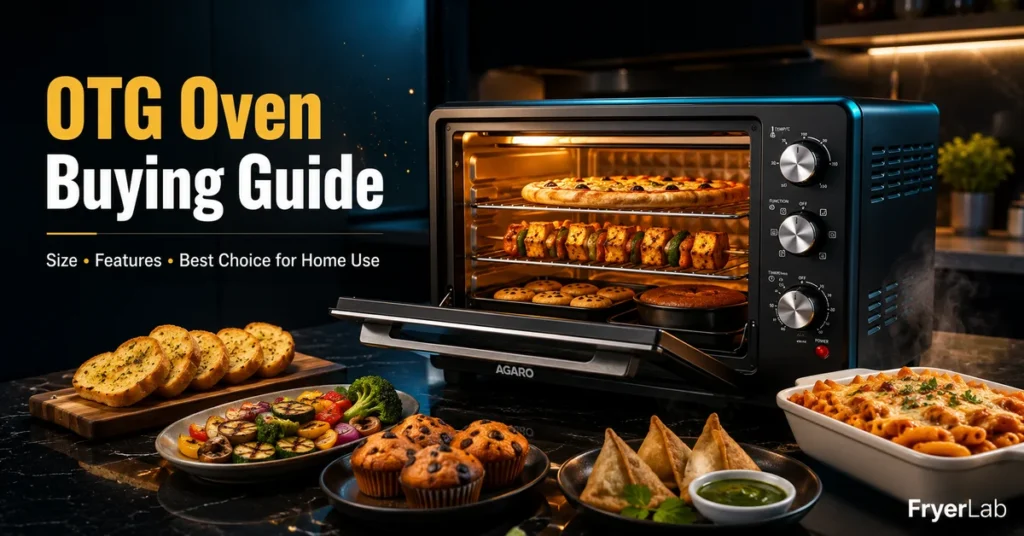
OTG Oven Buying Guide for Beginners in India
Buying your first OTG can be confusing. One model is 19 litres, another is 30…
Mixer Grinder Buying Guide India (2026): Expert Tips
Introduction A mixer grinder is one of the most important appliances in every Indian kitchen….
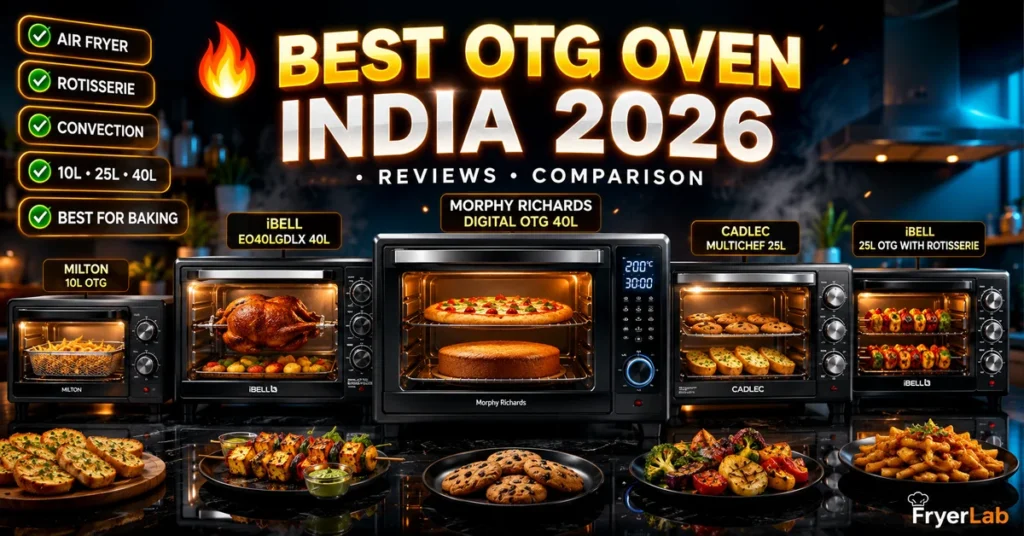
OTG Oven in India 2026: Best OTG Oven for Baking, Grilling
If you love baking cakes, making pizza at home, grilling paneer tikka, roasting chicken, toasting…
Induction Cooktop vs Gas Stove: Which Is Better for Indian Cooking? in 2026
Induction Cooktop vs Gas Stove Choosing between an Induction Cooktop vs Gas Stove is one…
Best Utensils for Induction Cooktop: Complete Buying Guide for Indian Kitchens
Best Utensils for Induction Cooktop: Complete Guide Induction cooking is becoming very popular in Indian…
Induction Cooker Under 3000: Best Picks in India 2026
Finding a good induction cooker Under 3000 is one of the smartest decisions for Indian…